
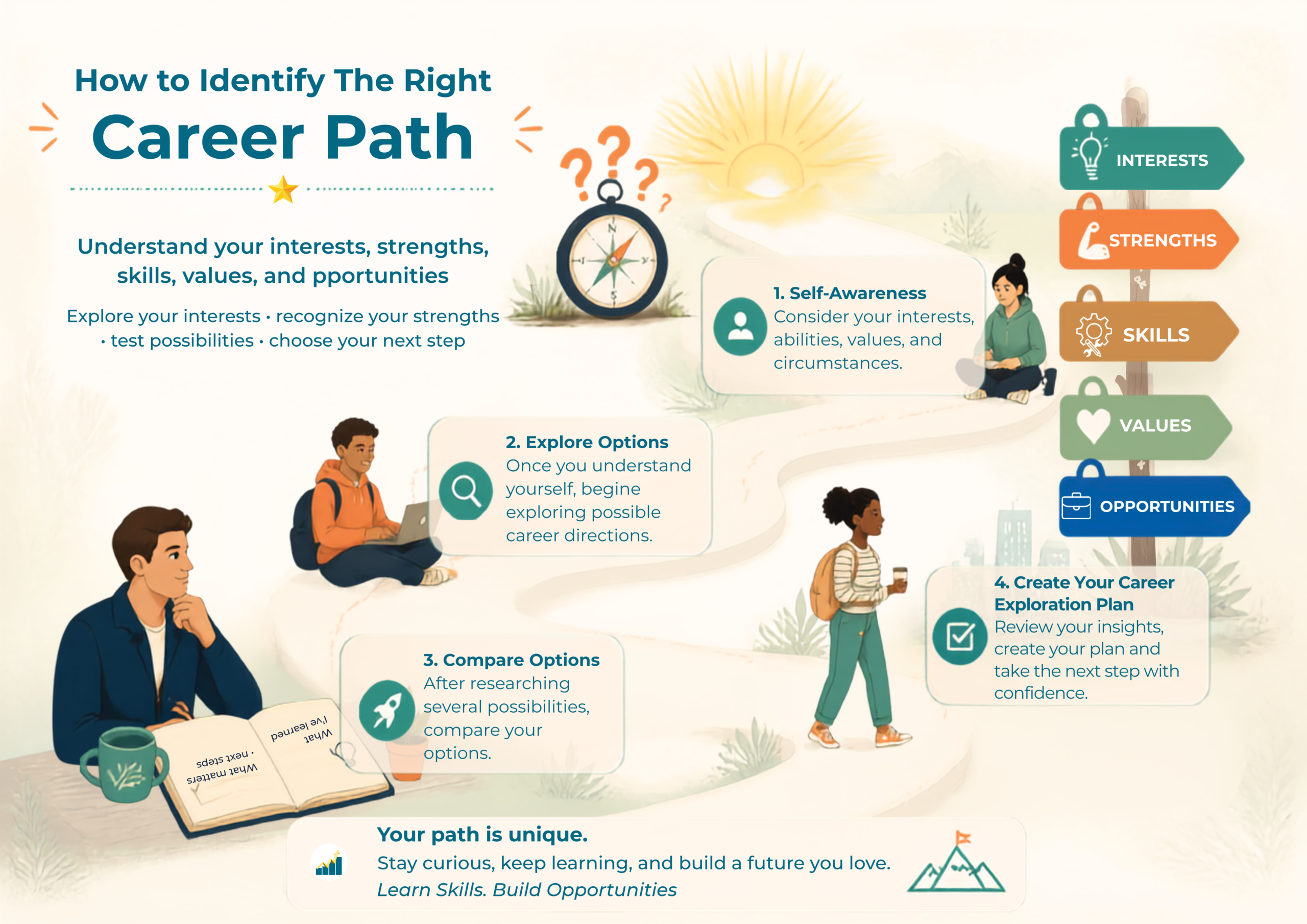
Choosing a career path can feel overwhelming, especially when you have many interests, different skills, or no clear idea of what you want to do next. Your may have completed your education, gained come work experience, or be considering a career change and still wonder, “What career is right for me?”
The good news is that you don’t have to figure out your entire career at once. Career direction can develop as you learn more about yourself, explore different opportunities, develop useful skills, and gain experience.
This guide will help you to begin that process by looking at your interests, strengths, skills, value, and opportunities. You will also complete practical activities to help you identify possible career directions and decide what you can explore next.
What You’ll Learn
By the end of this guide, you will be able to:
- Identify some of your interests and strengths.
- Recognize skills you already have and skills you may need to develop.
- Consider your values when exploring career opportunities.
- Research careers that match your interests and abilities.
- Compare possible career directions.
- Create a simple action plan for exploring your next step.
1. Start With Self-Awareness
Before searching for the “perfect” career, start by understanding yourself.
Your career choice should not be based only on what is popular, what other people expect from you, or what appears to pay well. Those factors can matter, but your interests, abilities, values, and circumstances should also be considered.
Start by asking yourself:
- What activities do I enjoy?
- What subjects or topics naturally interests me?
- What do people often ask me to help them with?
- What tasks do I learn quickly?
- What kind of problems do I enjoy solving?
- Do I prefer working with people, information, technology, ideas, or practical tasks?
- What kind of work environment would suit me?
You don’t need perfect answers. The purpose of these questions is to begin noticing patterns.
Practical Activity: Your Interest List
Write down five activities or subjects that genuinely interest you.
Don’t think only about formal career subjects.
For example:
- Teaching
- Cooking
- Technology
- Working with numbers
- Organizing events
- Writing
- Helping people solve problems
- Designing things
- Working with children
- Starting a business
Look for patterns in your list.
2. Identify Your Strengths
Your strengths are abilities or qualities that help you perform effectively.
Some strengths are technical, while others are personal or transferable.
For example:
Technical strengths
- Microsoft Excel
- Graphic design
- Accounting
- Data analysis
- Writing
- Programming
Transferable strengths
- Communication
- Organization
- Problem-solving
- Leadership
- Teamwork
- Creativity
- Time management
You may have strengths that you take for granted because they come naturally to you.
Think about situations where you have received positive feedback or successfully completed something difficult.
Ask yourself
“What am I already good at?”
Practical Activity: Your Strength List
Write down five strengths you believe you already have.
Then choose one person who knows you well and ask:
“What do you think I do particularly well?”
Compare their response with your own list.
You may discover strengths you had not recognized.
3. Understand Your Skills
Strengths and skills are related, but they aren’t exactly the same.
A skill is something you can learn, practice, and improve.
For example, you may have a natural strength in organization, while project management is a skill you can develop through learning and practice.
Create three lists:
Skills I Already Have
List skills you can currently demonstrate.
Skills I Am Developing
List skills you are currently learning or practicing
Skills I May Need
List skills that could help you move toward a career direction you are considering.
This simple exercise can help you see the difference between where you are now and where you may need to grow.
4. Consider Your Values
Career choices aren’t only about skills and salary.
Your values also matter.
For example, you may value:
- Flexibility
- Financial security
- Creativity
- Helping others
- Independence
- Stability
- Leadership
- Family time
- Continuous learning
- Making a difference
Understanding your values can help you identify work environments and career options that are more likely to suit you.
For example, someone who strongly values flexibility may want to explore careers that allow remote or flexible working arrangements.
Someone who values helping people may find meaning in careers involving teaching, counseling, healthcare, customer service, community development, or other service-oriented roles.
Your values don’t automatically determine your career, but they can help you make better-informed choices.
Explore Career Options
Once you understand more about your interests, strengths, skills, and values, begin exploring possible career directions.
Don’t limit yourself to the first career that comes to mind.
Choose three to five possibilities and research them.
For each career, find out:
- What does someone in this career actually do?
- What skills are required?
- What qualifications are commonly expected?
- What does a typical work day look like?
- What type of organizations hire people in this field?
- What opportunities exist for growth?
- Can the work be done remotely or internationally?
- What challenges might someone in this career face?
This is where research becomes important.
Don’t choose a career based only on it’s title.
Try to understand the work involved.
Remember, this is not your entry-level work. It is about your future.
6. Compare Your Options
After researching several possibilities, compare them.
You could create a simple table with these headings:
| Career Option | My Interest | My Current Skills | Skills I Need | Opportunities | Questions I Still Have |
| Career 1 | High/Medium/Low | Strong/Some/Little | List Skills | Research | Questions |
| Career 2 | High/Medium/Low | Strong/Some/Little | List skills | Research | Questions |
| Career 3 | High/Medium/Low | Strong/Some/Little | List Skills | Research | Questions |
You don’t need to find an option that scores perfectly in every category.
The purpose is to help you compare your options more intentionally.
7. Talk to people With Experience
Research can tell you a lot, but conversations can reveal things that aren’t obvious from websites or job descriptions.
If possible, talk to people who currently work in careers you’re considering.
Ask questions such as:
- How did you get started?
- What do you enjoy most about the work?
- What is challenging?
- Which skills are most important?
- What do you wish you had known when you were starting?
- What would you recommend someone to learn first?
You don’t need to know the person personally.
You might find people through professional networks, community organizations, alumni groups, events, or online professional communities.
Test Before You Commit
You don’t always need to make a major commitment before discovering whether a career interests you.
Look for small ways to test your interest.
You could:
- Take an introductory course.
- Volunteer.
- Complete a small project.
- Shadow someone.
- Attend a professional event.
- Join a relevant community.
- Offer your skills on a small project.
- Read books or articles about the field.
- Interview someone working in the career.
These experiences can help you move from:
“I think I might like this career.”
to:
“I’ve experienced some of the work, and now I have a better idea of whether it suits me or not.”
Create Your Career Exploration Plan
You don’t need to decide your entire future in one day.
Instead, choose one career direction you want to explore futher.
Then create a simple 30-day plan.
My Career Exploration Plan

Give yourself 30 days to explore rather than expecting yourself to have everything figured out immediately.
Remember: Your First Choice Doesn’t Have to Be Your Final Choice.
One of the biggest sources of pressure when choosing a career is the belief that you must make the perfect decision.
You don’t.
Your career can develop through exploration, learning, experience, and change. You can learn more about building your professional future in our Career Development guide.
A decision that seems right today may lead to a different opportunity tomorrow. That’s not necessarily failure. It can be part of discovering what works for you.
Instead of asking only:
“What career should I choose?”
Try asking:
“What career direction is worth exploring next?”
The second question can feel much more manageable.
Your Next Step
Take out a notebook or open a document and complete the Career Exploration Plan above.
Don’t try to figure out your entire career today.
Choose one direction.
Research it.
Talk to someone.
Learn a relevant skill.
Try something practical.
Then evaluate what you discover.
Your career journey doesn’t have to begin with having all the answers. It can begin with taking one informed step.
Your path is unique.
Stay curious, keep learning, and build a future you love.
Learn skills. Build opportunities.